No garage, narrow gate, small car. Where will the trike actually live?
Choosing and living with adult three-wheeled cycles, with and without electric assist
In short
- The distance between the outer edges of the two rear wheels is the number that decides whether a trike fits your property. Manufacturers publish it, but it is often listed below range, battery size and gearing.
- Rear baskets, mirrors, pedals at their outer sweep and pannier racks can all sit wider than the wheels themselves. Measure the assembled machine, not the frame drawing.
- A gate measured post to post is not the space you actually get once hinges, a latch and a closing stop are fitted. Measure the gap the gate leaves when it is fully swung open.
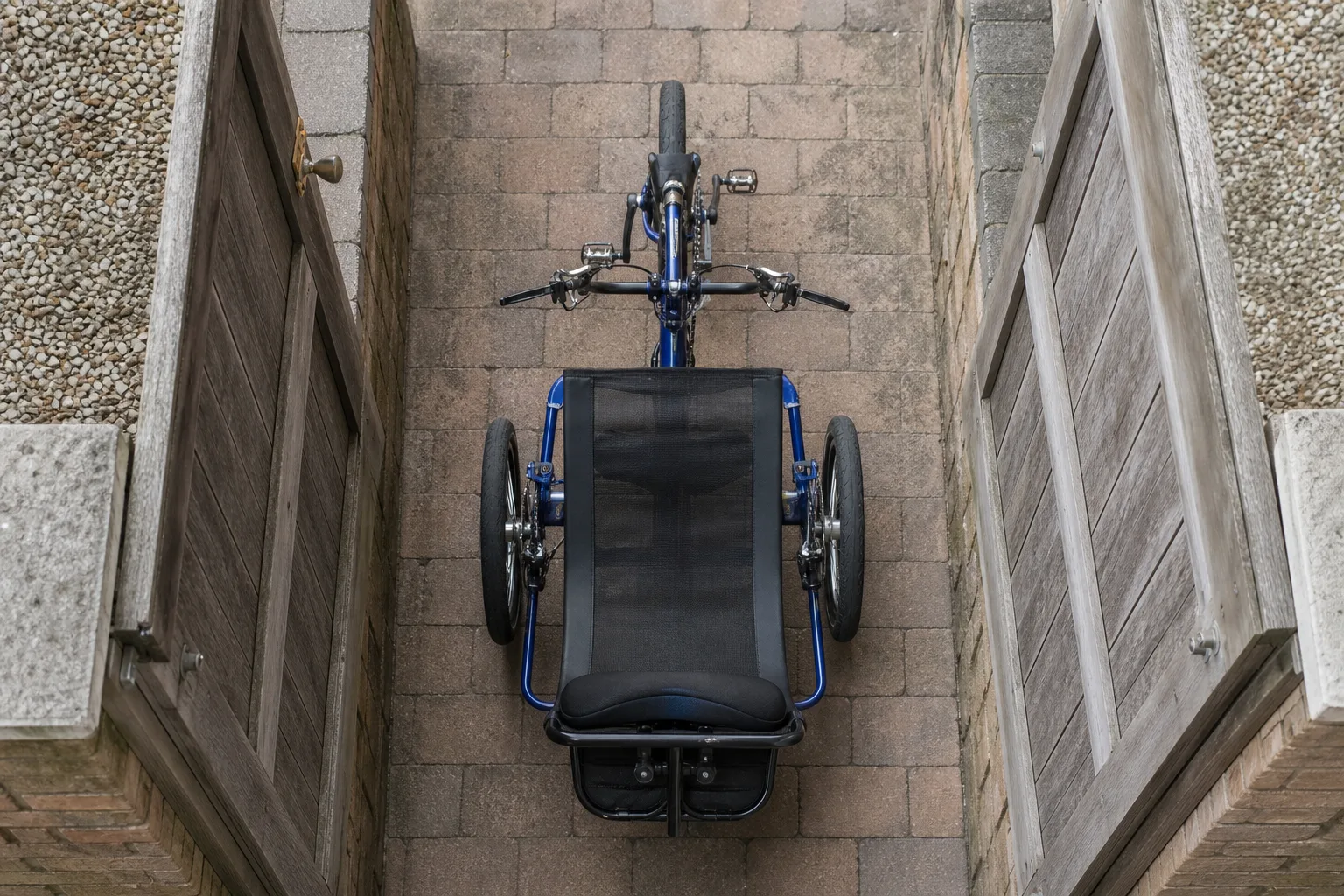
The measurement that decides whether an adult trike works for you is rarely listed first on a spec sheet, and it is not the motor wattage, the battery capacity, or the gear range. It is the overall track width at the rear axle, followed closely by the weight you would have to lift if the trike ever needed to come off the ground. A two-wheeled bike can be turned sideways, tilted, hung on a hook, or walked through a gap barely wider than its handlebars. A trike cannot do any of that. It goes where its widest point fits, and nowhere else.
Measure the gap before you compare models
Adult trikes commonly run somewhere between the width of a wide wheelbarrow and the width of a small garden bench, and manufacturers usually quote that figure honestly, though they quote it at the axle rather than at the widest point, which may be a pedal, a mirror, or a rear basket. Take a tape measure to the tightest point on the route the trike will travel every day: the garden gate posts, the side passage between house and fence, the shed doorway, the garage door track. Write down the narrowest number you find, then subtract two inches for the fact that nobody steers perfectly. That figure, not the price, is your first filter.
Garage doors are usually generous, but the clear opening of a hinged garden gate is often four or five inches narrower than the gate itself once the hinge side and the latch hardware are counted. Shed doors are worse. A standard single shed door is frequently too narrow for a full-width trike, which is why owners so often end up either widening the opening, replacing the door with a double, or storing the trike under a cover on a hard standing.
Weight, and the moments when lifting is unavoidable
Most days you will never lift a trike. You will roll it. The problem is the exceptions: a single step at the back door, a curb with no dropped section, a threshold strip, a loading ramp. An unassisted steel trike is heavy enough that a two-handed drag is the honest method rather than a lift, and an electric trike with a rear hub motor, a battery, and a cargo basket can be substantially heavier again, with most of that weight concentrated over the rear axle where you have the least leverage.
Two things reduce the problem more than any strength training will. The first is a removable battery, which takes several pounds out of the frame and can be carried separately. The second is a ramp, either a folding aluminum threshold ramp for a single step or a longer channel ramp for a curb. A careful reader checks whether the battery lifts out without tools and whether the rear axle assembly clears a ramp lip, because those two answers change daily handling more than the headline weight does.
What folding designs give you, and what they cost
Folding trikes exist and they genuinely work, but the fold is not the same trick as on a folding bicycle. Most fold at the main frame hinge and at the handlebar stem, which shortens the machine and drops its height, while the rear track narrows only if the design also folds or removes the rear wheels. Read the folded dimensions carefully: a trike that folds to half its length but keeps its full width still will not pass through a narrow gate.
The trade is stiffness and service life. A hinge in the main tube adds flex under pedaling load, adds fasteners that need periodic checking, and adds a wear point that a one-piece frame does not have. Folding models also tend to weigh a little more for the same capability, because the hinge hardware is not free. For someone storing a trike in an apartment or hauling it regularly, that is a fair price. For someone with a garage, it is a cost with no return.
Getting it into a car
Very few adult trikes fit inside a sedan trunk, and the ones that do are folding models with quick-release rear wheels. A minivan or an SUV with the rear seats folded flat is the realistic minimum, and even then the loading height matters as much as the cargo volume. The alternative is a hitch-mounted platform carrier rated for the trike's weight, which is the route most owners settle on. Check the carrier's rated capacity against the trike weight including battery, and confirm your vehicle's hitch class, since the Consumer Product Safety Commission oversees safety requirements for the cycles themselves while the carrier and hitch are a separate rating question entirely.
Inside the house, the path matters more than the room at the end of it. Front door clear width, hallway turns, and any interior threshold all have to accept the widest point, and a ninety degree turn in a hallway needs roughly the trike's length in clear floor to swing through.
Decide the storage location first. Then shop for a trike that fits it, and the rest of the specification becomes a pleasure to choose rather than a compromise you discover later.